
We all know the feeling of entering the interview and trying to impress the higher-ups with a single sentence, too bad that it will be like climbing Mount Everest. As of nowadays the higher the need gets higher the demand gets. If we need a high-value job, we must show them we have the capability and capacity to get it. We are expected of solving problems in less possible ways but effective. So we are going to see about one-liner functions.
Life creates opportunities on our way. But definitely won’t help us in any of them. Such us impressing a person you like! Which are a complex and time-consuming process. Our problems in life can’t be expressed in one line or a single sentence.
But in Python, we don’t have to face that kind of problem when handling programs. Because of a magical function which solves most of the simple complex and time-consuming problems in a single line.
One-line functions allow developers the ability to achieve time-consuming tasks in a single line of code.
In this article, we will see into a couple of one-liners in Python and their advantage and how to utilize them in coding programs.
1. Lambda Function
In Python, the one-line function is also known as a lambda function, which is a compact and anonymous function that can be defined by a single line of code. Unlike regular functions created using the ‘ def ’ keyword. Lambda functions do not require a name and are often used for short, temporary operations.
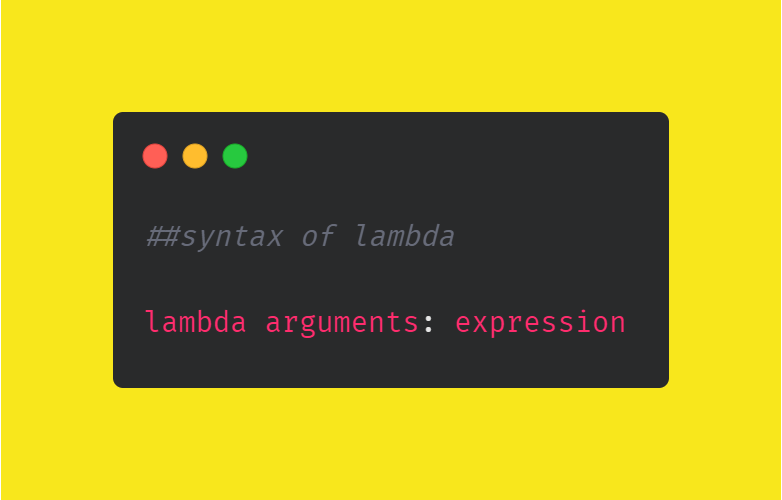
The ‘ arguments ‘ represent the input parameters, and the ‘ expression ‘ is the condition performed using the arguments.
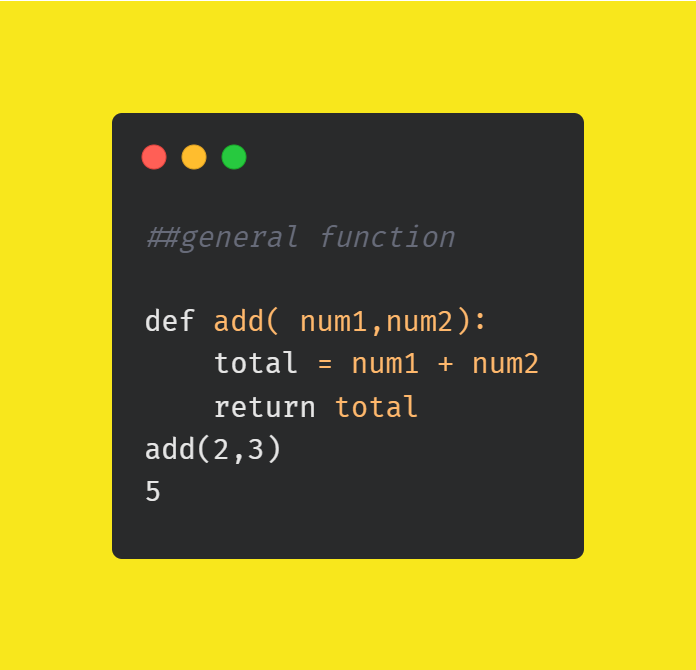
In the above example, we can find that we have defined an add() name function with two parameters such as def add(num1,num2).
total = num1+num2: in this line, the function calculates the sum of num1 and num2 and stores its value in total.
return total will return the value of the total as the output of the function.
In the example, ‘ add(2,3) ‘ will be called and it will return the sum of ‘2’ and ‘3’ which is ‘5’ as the output.
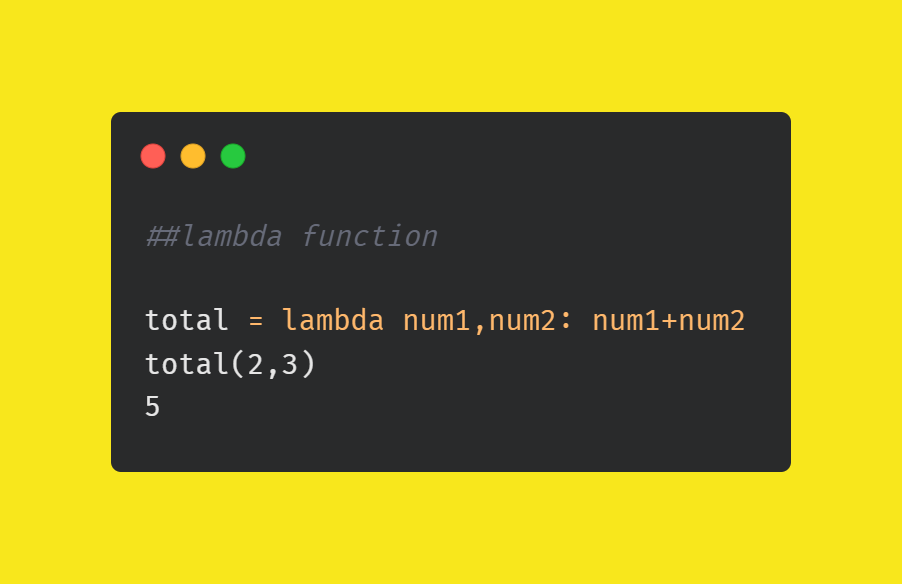
As we know lambda function is anonymous which doesn’t requires any name functions, we can directly pass parameters. The above lambda function takes the argument num1, num2 and performs addition operation num1 + num2 and returns the result. In the example, lambda function ‘ total(2,3) ‘ will be called and it will return the sum of ‘2’ and ‘3’ which is ‘5’ as the output.
2. Ternary operators
Ternary operators which are also known as conditional expressions offer a powerful way to write a single-line code more effectively and easily. Ternary operators consist of if-else statements. The name ternary refers to the fact that these operators involve three components: a condition, a value if the condition is true, and a value if the condition is false.
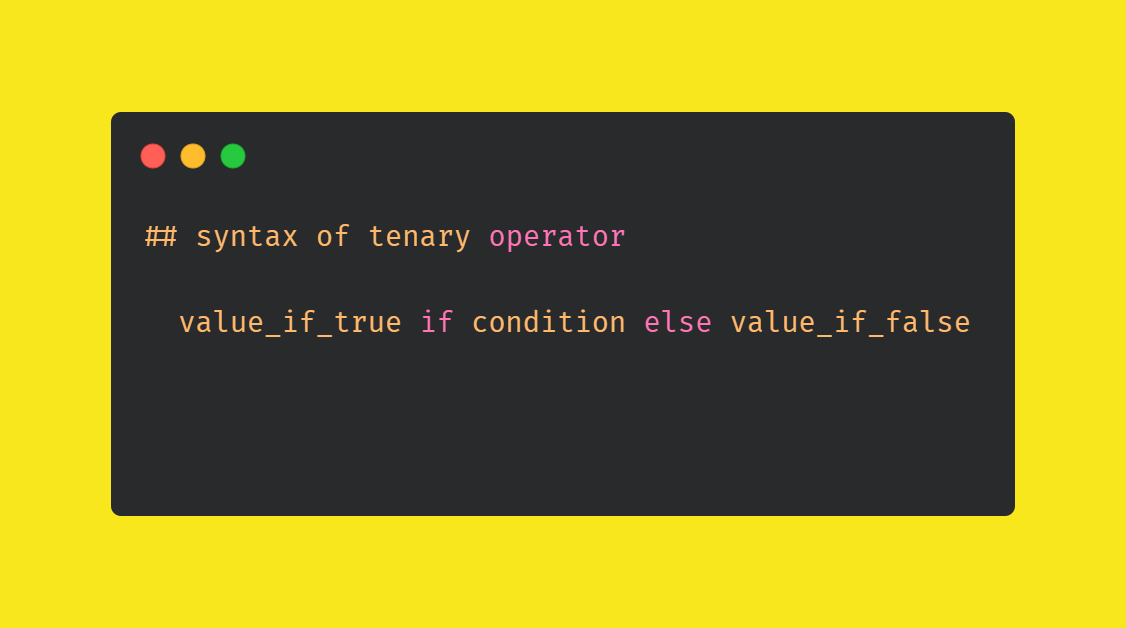
value_if_true: value assigned if the condition is true.
condition: condition of the operation.
value_if_false: value assigned if the condition is false.
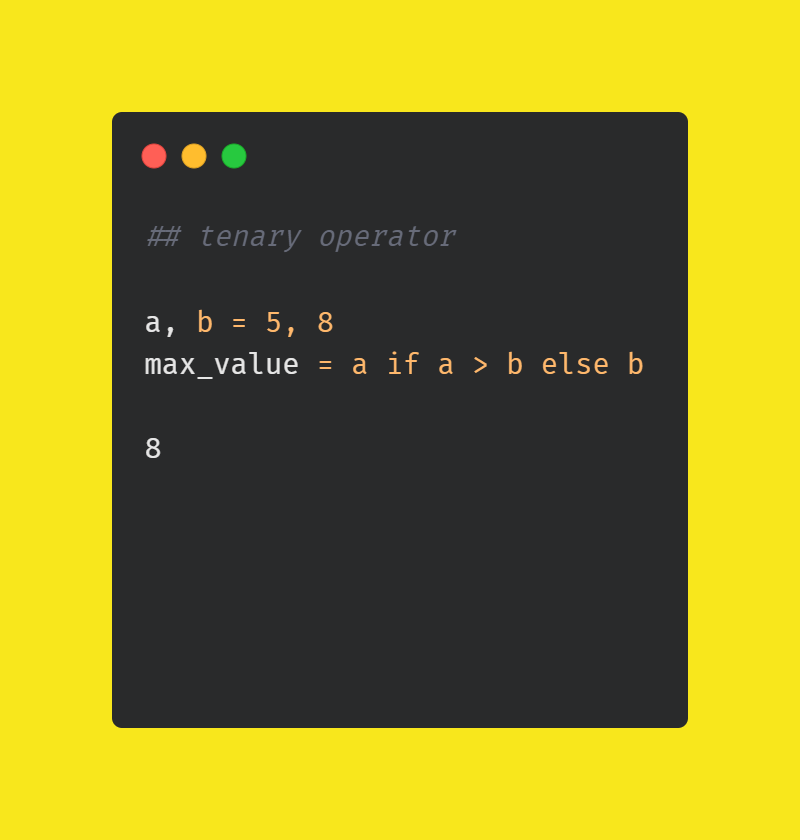
We established two variables such as a and b and assigned values of 5 and 8 respectively. The ternary operator is used to compare the values a and b. If the a>b is true the value of ‘ a ‘ will be assigned as max_value if not true then the value of ‘ b ‘ will be assigned as max_value.
In our case a > b is false so b is the max_value between a and b. So the max_value is 8.
3. List comprehension
List comprehensions give a compact way to create lists in Python by combining existing lists with conditions. It acts as an alternative to for-loop when creating lists with more readable and effective.
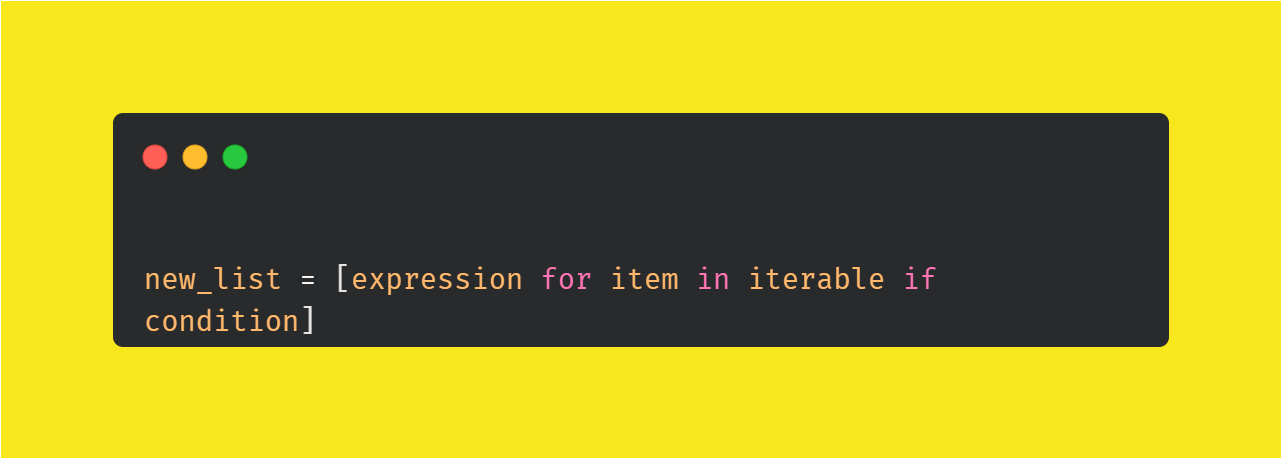
New_list will be the output from the list comprehension. The expression is the operation or the condition with which we want to proceed. items represent each element in the iterable. iterable is the existing list. Conditions are known to the specific case to filter the list.
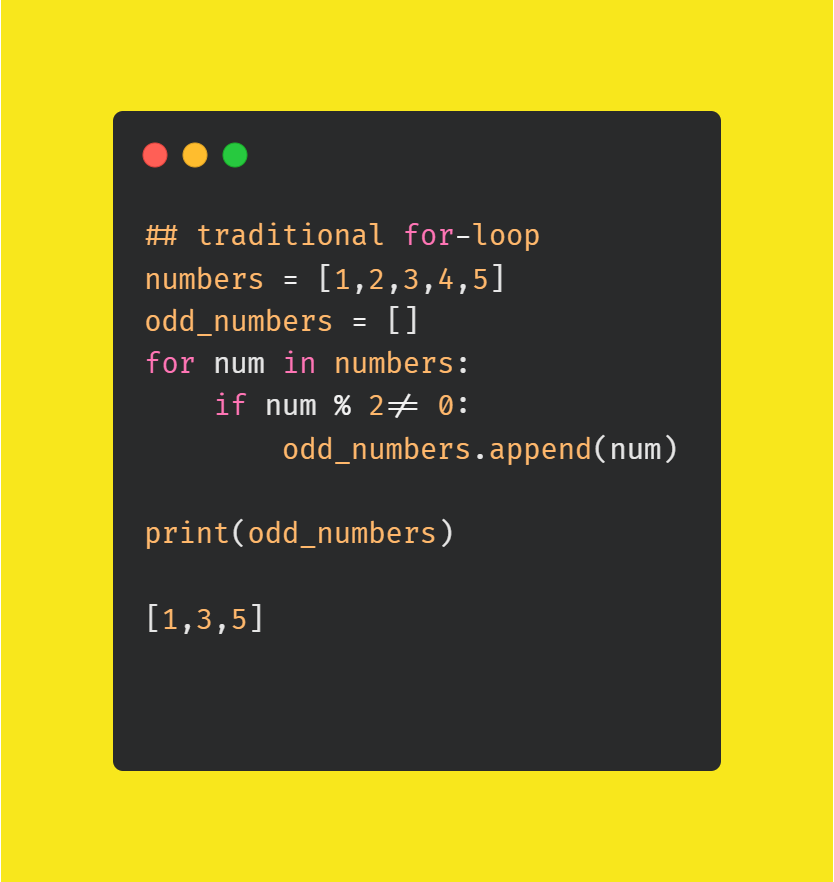
In the above example which is known to be a traditional method, we have a list of named numbers containing integers of 1–5. Our goal is to filter those numbers which are divisible by 2 into a new list called odd_numbers.
We use a for-loop over element(num) in the numbers list with the if condition to filter odd numbers from the numbers list. We did that by using the modulo operator %, which gives the remainder of the num which is divisible by 2. If the remainder is not equal to 0 it is an odd number. So we append it in the odd_numbers list.
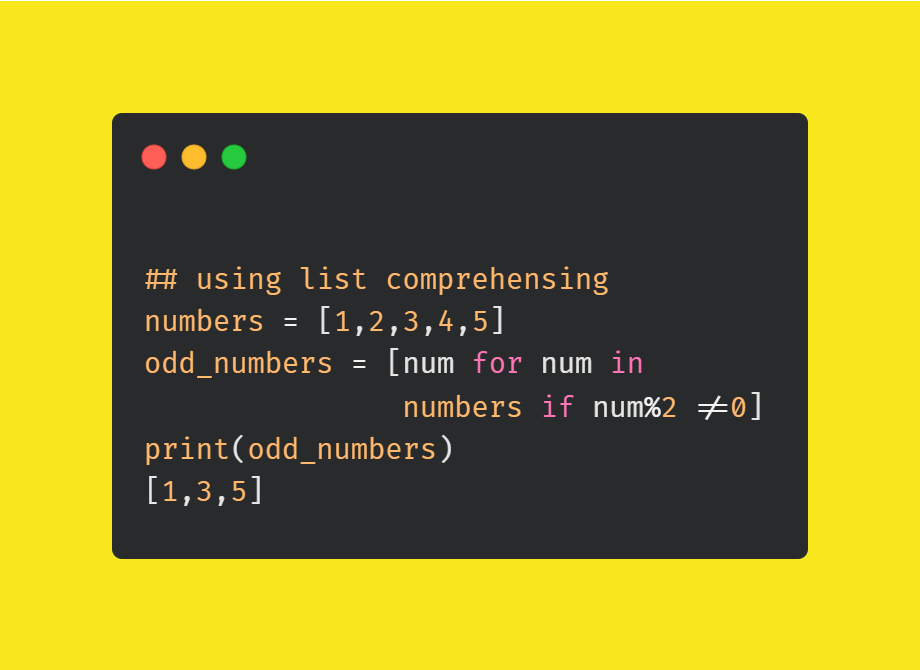
We will use the ternary operator to attain our odd_numbers, for each element, it evaluates the if condition (num% 2 != 0) if the condition is true, then the number is added to the new list. If the condition is false then it skips the element and will not add it to our new list of odd_numbers.
Advantages of one-line functions:
The primary benefit of one-liners is their length which is very short. Thus why they were preferred in a situation that required short and simple operations that can be easily readable.
Lambda functions are anonymous so they don’t have a name. Which makes them ideal for small tasks that do not require extensive documentation.
Ternary operators are used as an alternative for the if-else statement with a compact and simple function.
List comprehensions offer a streamlined and readable way to create new lists while performing data transformations and filtering with ease.
One-liners work perfectly with functional programming so that the developers can easily pass arguments to other functions.
When to use one-liners:
One-liners are powerful tools when it comes to short and simple operations which do not compromise the readability of the program. For complex tasks and operations such as extensive documentation, it is wise to use naming functions.
Conclusion:
Python’s one-line functions offer developers a practical and compact way to perform quick operations. While lambda functions, List comprehension and ternary operators can use functional programming it is not always considered to be a powerful tool of choice for every situation. There are more one-liner options in Pythons rather than what we have seen here.
On comparing what we discussed in this article and what is yet to be explored we can say Python is salt in the ocean but instead of salt, we get functions and methods to simplify tasks in exploring Python. By using the one-liner function developers can write simple, readable and effective code only if they know the one-liner function and understand it.